

One of the first questions nearly every aspiring author asks is:
“How much does it cost to edit a book?”
It’s a sensible question—but it’s also one of the hardest to answer with a single number. Of course, during a telephone conversation, when I have all the details at hand, I can give someone an estimate, but without this, it isn’t easy to give an accurate answer. Without a meeting and more detailed information on your manuscript, the answer is, “it depends.”
Unlike printing a book or purchasing an ISBN if you are reading this in the US (in Canada, ISBNs are free), editing isn’t a standardized service. Every manuscript arrives at a different stage of development. Some need help with the overall structure. Others are beautifully organized but require stronger prose. Structure vs craft, sometimes what needs improving is both. Still others simply need a meticulous final proofread before publication.
That’s why professional editing costs can range anywhere from $1,200 USD to $8,000 USD or more for a full-length manuscript. The price depends less on the word count than on what your manuscript actually needs.
This short guide explains:
- what each type of editing costs
- what influences your quote
- why editing prices vary so widely
- how to avoid paying for the wrong service
- whether AI can replace a professional editor
- how to choose the right editor for your book
Over the weeks, we’ll discuss some of these points in greater detail. For now, this guide will leave you confident about what to expect if you were to approach me or any professional editor for support with your manuscript. Whether you’re writing a memoir, novel, business book, or self-help guide, understanding the editing process will help you invest wisely and produce a book you’re proud to publish.
Typical Book Editing Costs
The following ranges reflect common industry pricing for a manuscript between 60,000 and 80,000 words.
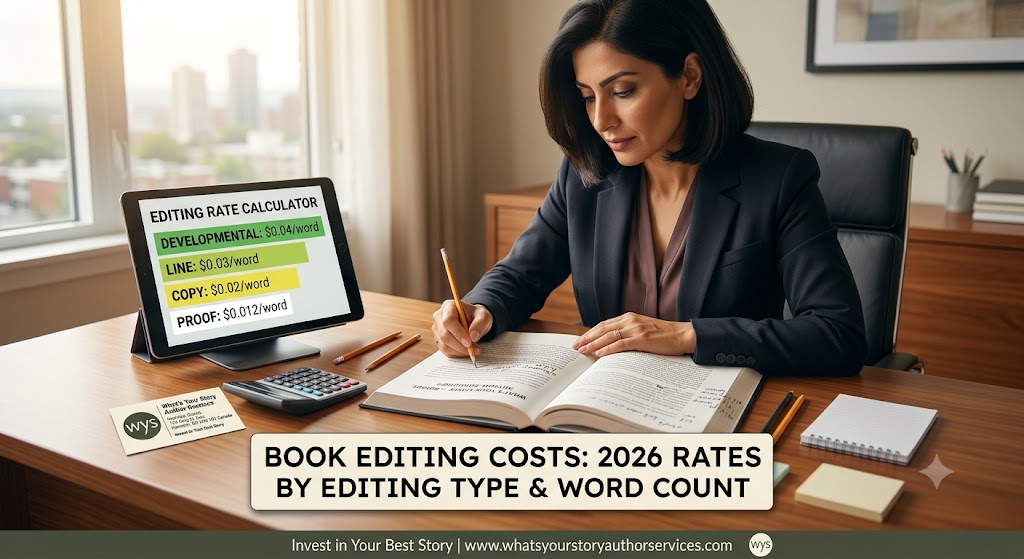
| Editing Type | Typical Cost (USD) | Purpose |
| Developmental Editing | $0.03–$0.06 per word | Structure, organization, story, argument |
| Line Editing | $0.025–$0.04 per word | Style, voice, readability |
| Copyediting | $0.018–$0.03 per word | Grammar, punctuation, consistency |
| Proofreading | $0.012–$0.02 per word | Final review before publication |
These are averages rather than fixed prices. Some editors charge more based on experience or specialization, while others charge less because they provide a lighter edit or are building their portfolios.
The most important question isn’t “What’s the cheapest editor?”
It’s:
“What level of editing does my manuscript actually need?”
The Four Levels of Book Editing
Understanding these four services can save you thousands of dollars.
Many first-time authors accidentally purchase the wrong type of editing. For example, paying for a line edit before resolving structural problems often means paying twice, because the edited pages are later rewritten. For example, if a book comes to me that is half the word-count that a book of its genre should be, it will have obvious structure and craft issues. The best option is an assessment, not a line edit. Yes, many authors will expect a line edit and receive and pay for one. Then when they add the material necessary, another line edit may be required.
Let’s look at each stage.
1. Developmental Editing
Average Cost: $0.03–$0.06 per word
Developmental editing examines the book as a whole.
Rather than correcting grammar, the editor looks at questions like:
- Is the story engaging?
- Does the argument build logically?
- Are the chapters in the right order?
- Are important scenes missing?
- Is the pacing working?
- Does the ending feel satisfying?
- Are readers likely to stay engaged?
For memoirs, developmental editing often uncovers places where the author has summarized emotional experiences instead of bringing them to life through scenes.
For nonfiction, it frequently reveals where the teaching sequence could be clearer or where examples need strengthening. Where there are holes in the thesis.
For novels, it focuses on plot, character development, conflict, pacing, and emotional payoff.
Think of developmental editing as designing the blueprint before decorating the house.
Best for: First drafts, major revisions, first-time authors, and books that have never received professional feedback.
2. Line Editing
Average Cost: $0.025–$0.04 per word
Once the overall structure is working, attention shifts to the writing itself.
Line editing improves:
- sentence flow
- clarity
- rhythm
- transitions
- word choice
- dialogue
- emotional impact
- consistency of voice
This is where good writing becomes memorable writing.
A line editor doesn’t change your voice—they help your voice come through more clearly.
A mentor editor said the goal in line editing is to be invisible. One of my favourite testimonials is this one: “It sounds like me, only 10,000 times better.”
Best for: Manuscripts with strong structure that need more polished prose.
3. Copyediting
Average Cost: $0.018–$0.03 per word
Copyediting focuses on technical accuracy.
This includes:
- grammar
- spelling
- punctuation
- capitalization
- consistency
- style guide adherence
- continuity
- formatting consistency
Good copyediting is often invisible. The things a copyeditor is looking for is whether you write the numbers out in full all the time, or only when it is ten or above. For example, 578 or five hundred seventy-eight. They ensure that if you write US in one place, you aren’t writing USA or United States in another. That you either use, or do not use the Oxford comma (let’s not fight here: always use the Oxford comma!).
Readers rarely notice excellent copyediting—but they almost always notice poor copyediting.
Best for: Manuscripts that are essentially finished and ready for publication.
4. Proofreading
Average Cost: $0.012–$0.02 per word
Proofreading is the final quality check after the book has been professionally laid out.
It catches:
- typographical errors
- formatting issues
- incorrect page numbers
- spacing problems
- broken headings
- inconsistent fonts
- layout glitches
Proofreading is not another copyedit.
It happens after the interior design is complete and immediately before publication.
Why Does Professional Editing Cost So Much?
Many authors experience sticker shock when they first receive an editing quote. Why does editing cost so much? The reason is simple.
Professional editing is extraordinarily time-intensive.
An experienced editor doesn’t read your manuscript the way an ordinary reader does. They read every sentence multiple times while simultaneously considering:
- clarity
- consistency
- pacing
- grammar
- continuity
- structure
- reader expectations
- market conventions
A thoughtful developmental edit or copyedit can require 40 to more than 100 hours of concentrated work.
You’re not simply paying for time. You’re paying for years—often decades—of professional experience, publishing knowledge, and editorial judgment.
Good editing can transform a manuscript.
Great editing can transform an author’s career.
And it can sometimes require a team: look at the acknowledgements page of your favourite book. List the number of editors they thank. Agents and publishers do not accept work in development. They require you to have invested in professional editing. The surest way to receive a rejection is to send in a manuscript with the signs of not being editing. Those signs? Poor readability because of flaws that a professional editor would immediately spot and help you to fix.
What Influences the Cost?
Several factors affect your final quote.
Word Count
Longer books require more editorial time.
Although editing is commonly priced per word, word count isn’t the only consideration. An exceptionally clean 90,000-word manuscript may require less work than a disorganized 50,000-word manuscript.
Genre
Certain genres demand specialized expertise.
For example:
- academic writing
- historical nonfiction
- technical manuals
- medical texts
- legal writing
Editors with specialist knowledge often charge higher rates.
Manuscript Readiness
This is usually the biggest factor.
A manuscript requiring light copyediting costs considerably less than one needing significant restructuring.
Professional editors often assess the manuscript before providing a quotation because they need to understand the level of intervention required.
Turnaround Time
Rush projects usually carry an additional fee.
Completing an edit in one week rather than four to six often means rearranging existing commitments.
Do You Need All Four Types of Editing?
Not necessarily.
Every manuscript is different.
For example:
Scenario One
A first-time memoir writer.
Likely needs:
Developmental Editing → Line Editing → Copyediting → Proofreading
Scenario Two
An experienced business author working from a proven framework.
Likely needs:
Manuscript assessment → Copyediting → Proofreading
Scenario Three
A traditionally published novelist whose manuscript has already undergone developmental revisions with an acquiring editor.
Likely needs:
Line Editing → Copyediting → Proofreading
The goal isn’t to purchase every service.
It’s to purchase the right service.
Cheap Editing vs. Good Editing
Every author has a budget; there’s nothing wrong with seeking value. However, there is a difference between low cost and good value.
A good editor will have all of this covered:
- experience
- communication
- publishing background
- testimonials
- contract clarity
- turnaround
- specialization
- the depth of feedback provided
An inexpensive edit that misses significant problems often becomes far more expensive later.
Likewise, the highest-priced editor isn’t automatically the best choice.
Look for someone who understands your goals, communicates clearly, and explains why they recommend a particular level of editing. When I speak to someone another factor is availability: can this editor deliver my manuscript when I want it and/or am I able to wait until they are available. Afterall, a good editor is likely to have other clients and will give you a delivery date based on juggling your project with their other ones.
Can AI Replace a Professional Editor?
Artificial intelligence has become an increasingly useful writing tool.
It can help identify:
- repetitive wording
- awkward sentences
- grammar errors
- spelling mistakes
- readability issues
Those are genuine strengths.
However, AI still struggles with many of the areas that matter most in book publishing.
For example:
- emotional pacing
- memoir authenticity
- character arcs
- narrative tension
- theme
- chapter sequencing
- reader psychology
- knowing what should remain unsaid
So, AI is an excellent assistant; but it is not a substitute for an experienced developmental editor or book coach.
Many professional editors—including our team—use AI to improve efficiency while relying on human judgment to make the editorial decisions that shape a successful book. We all use AI in one way or another right now–those squiggly lines that draw your attention to typos are AI. Autocorrect is AI.
It is a good idea to ask your editor how they use AI and this is a conversation I’ve have with many clients. I now include it in my contract. I also ask that writers tell me how they’ve used AI so I can help them create work that is original and satisfying to a reader. A lot of AI has tells and ways of writing that signal its use right away. For example, I bought a book to help me improve my Spanish and they didn’t even edit away that odd bolding pattern that ChatGPT uses. That and other tells made my experience as a reader unsatisfactory and I even felt ripped off.
Questions to Ask Before Hiring an Editor
Before signing an agreement, ask:
- What type of editing do you recommend?
- Why do you recommend that level?
- What experience do you have with my genre?
- What will I receive at the end of the edit?
- Will I receive an editorial letter?
- How many passes through the manuscript are included?
- What happens if the manuscript needs more work than expected?
- What style guide do you use?
- What is your turnaround time?
- Can you explain your editing philosophy?
- How do you use AI in your work?
These questions often reveal far more than price alone.
Red Flags to Watch For
Be cautious if an editor:
- guarantees publication or bestseller status
- cannot explain what type of editing you need
- offers no contract or written agreement
- edits without first assessing the manuscript
- promises unrealistically fast turnaround
- has little experience in your genre
A professional editor should be transparent about both the process and the expected outcomes.
Frequently Asked Questions
Can I edit my own book?
Yes—but every author has blind spots.
After working with a manuscript for months or years, it becomes difficult to see missing words, unclear passages, or structural problems.
Professional editing provides the fresh perspective every book eventually needs.
Should I hire an editor before querying literary agents?
Yes.
Agents expect submissions to be as strong as possible—”shelf ready” as they say.
While not every manuscript requires every level of editing, thoughtful professional feedback often makes a significant difference.
Is proofreading enough?
Usually not.
Proofreading assumes the manuscript has already been professionally edited.
If the structure, clarity, or grammar still need work, proofreading alone won’t solve those issues.
How long does editing take?
Depending on the manuscript and the editor’s schedule, editing typically takes between two and eight weeks.
Large or complex projects may take longer.
Is editing worth the investment?
If your goal is to publish a professional-quality book, almost always.
Readers notice quality—even if they can’t identify exactly why one book feels polished and another doesn’t.
Professional editing improves credibility, readability, and the overall reader experience.
Our Approach at What’s Your Story Author Services
At What’s Your Story Author Services, we believe one of the most expensive mistakes an author can make is paying for the wrong kind of editing.
Rather than assuming every manuscript needs the same service, we begin with a comprehensive manuscript assessment. This allows us to identify the manuscript’s strengths, areas for improvement, and the level of editorial support that will provide the greatest benefit.
Our approach combines editorial expertise with coaching, helping authors understand not only what needs to change but why. We believe that better writers produce better books, and our goal is to strengthen both.
Editorial packages typically begin at CAD $3,500, with copyediting priced separately according to manuscript length and the amount of editorial intervention required. More extensive developmental support, collaborative revision, or ghostwriting is quoted individually based on the project’s scope.
We believe editing should be an investment in your book—not an unnecessary expense.
Final Thoughts
Professional editing is one of the most important investments you’ll make in your publishing journey.
The right editor doesn’t simply correct mistakes. They help you communicate more clearly, tell a stronger story, and create a book that readers will remember.
If you’re unsure what level of editing your manuscript needs, don’t worry—you don’t have to figure it out alone.
Start with an expert assessment. Understanding where your manuscript stands today is often the smartest and most cost-effective first step toward publishing a book you’re proud to share with the world.


0 Comments